

What Is the Bill of Rights — and Who Does It Protect?
When the Constitution was written in 1787, it created a brand-new government. It set up a president, Congress, and courts. But many Americans had a serious concern:
What would stop this new government from becoming too powerful?
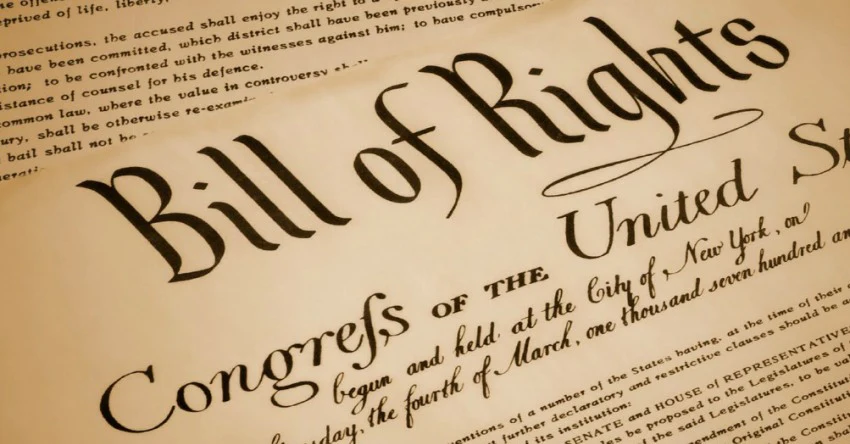
That concern led to the Bill of Rights — the first ten amendments to the Constitution, ratified in 1791. Written mainly by James Madison, these amendments were designed to do one essential thing:
Limit government power and protect individual freedom.
They were influenced by earlier documents like the Virginia Declaration of Rights, the Magna Carta, and the English Bill of Rights — all of which tried to place boundaries on rulers.
The Bill of Rights is not about giving the government power.
It is about placing clear limits on what the government can do.
Why the Bill of Rights Was Added
After the Constitution was written, Americans debated whether it needed a list of specific rights.
- Federalists believed the Constitution already limited government power.
- Anti-Federalists feared the national government might become too strong and demanded written protections for individual liberty.
To compromise, Madison proposed amendments instead of rewriting the Constitution. Congress approved them, the states ratified ten, and together they became the Bill of Rights.
December 15, 1791, marks their official adoption.
The First Ten Amendments Explained
First Amendment — Freedom of Religion, Speech, Press, Assembly, and Petition
“Congress shall make no law respecting an establishment of religion, or prohibiting the free exercise thereof; or abridging the freedom of speech, or of the press; or the right of the people peaceably to assemble, and to petition the government for a redress of grievances.”
The First Amendment protects five essential freedoms that form the foundation of American democracy:
- Freedom of religion
- Freedom of speech
- Freedom of the press
- Freedom of assembly
- Freedom to petition the government
Together, these freedoms protect your voice and your beliefs.
Freedom of Religion
The government cannot establish an official national religion. This is often called the Establishment Clause.
At the same time, the government cannot stop you from practicing your faith — or choosing not to follow any religion at all. This is known as the Free Exercise Clause.
The First Amendment protects both belief and personal religious practice.
Freedom of Speech
You have the right to express your opinions — even if they criticize the government. This includes spoken words, written ideas, art, and symbolic expression.
However, free speech is not unlimited. Certain types of speech, such as direct threats or incitement to violence, are not protected.
Freedom of the Press
The press — newspapers, journalists, media organizations — has the right to report on government actions and public issues without censorship. A free press helps hold leaders accountable and keeps citizens informed.
Freedom of Assembly
People have the right to gather peacefully to share ideas, protest policies, or support causes. Peaceful protest has played a major role in American history, from the civil rights movement to modern demonstrations.
Right to Petition
Citizens have the right to ask the government to fix problems. This can include signing petitions, writing letters, speaking at public meetings, or filing lawsuits.
In simple terms:
The government cannot:
- Establish a national religion
- Stop you from practicing your faith
- Silence your speech or writing
- Prevent peaceful protests
- Stop you from asking leaders to address grievances
The First Amendment protects open discussion and diverse beliefs. It allows disagreement. It protects criticism. It encourages civic participation.
At its heart, the First Amendment safeguards democracy itself. A free society depends on people being able to think, speak, worship, gather, and advocate without fear of government punishment.
It ensures that power can be questioned — and that every person has the right to be heard.
Second Amendment — The Right to Bear Arms
“A well-regulated militia, being necessary to the security of a free state, the right of the people to keep and bear arms, shall not be infringed.”
The Second Amendment protects the right of the people to keep and bear arms.
When it was written in 1791, the United States did not have a large standing national army like it does today. Instead, local militias — groups of ordinary citizens who could be called upon for defense — played an important role in protecting communities and the new nation.
The amendment connects two ideas:
- A well-regulated militia is necessary for the security of a free state.
- The right of the people to keep and bear arms shall not be infringed (limited or taken away).
Historical Context
In the late 1700s:
- Many Americans distrusted large standing armies.
- Local militias were seen as protection against foreign invasion and potential government tyranny.
- Citizens were often expected to bring their own weapons when serving in a militia.
Because of this history, the amendment linked the right to bear arms with the idea of maintaining a free state.
Modern Interpretation
Today, the Second Amendment remains one of the most debated parts of the Constitution.
Over time, the Supreme Court has interpreted the amendment to protect an individual right to possess firearms for lawful purposes, such as self-defense. At the same time, courts have also recognized that the right is not unlimited and that certain regulations may be constitutional.
This ongoing debate involves questions such as:
- What kinds of regulations are allowed?
- How should public safety and individual rights be balanced?
- How should the phrase “well-regulated militia” be understood today?
In simple terms:
The Second Amendment protects the right to keep and bear arms, but the exact boundaries of that right continue to be discussed and defined through laws and court decisions.
At its heart, this amendment reflects two core constitutional themes:
- The importance of individual liberty
- The role of citizens in preserving a free society
Like many parts of the Constitution, the Second Amendment requires careful interpretation. It reminds us that constitutional rights often involve balancing freedom, safety, and democratic decision-making.
Understanding this amendment means understanding both its historical roots and its modern legal debates.
Third Amendment — No Forced Housing of Soldiers
“No soldier shall, in time of peace be quartered in any house, without the consent of the owner, nor in time of war, but in a manner to be prescribed by law.”
The Third Amendment protects your home from being taken over by the military.
It says the government cannot force soldiers to live in your house during peacetime without your permission. Even during wartime, soldiers can only be housed in private homes if a law clearly allows it.
To understand why this matters, we need to look at history.
Before the American Revolution, British soldiers were sometimes housed in colonists’ homes against their will. The British government passed laws — known as the Quartering Acts — that required colonists to provide lodging and supplies to soldiers. Many colonists saw this as a serious violation of their privacy and property rights.
When the Constitution was written, the Founders wanted to make sure this kind of abuse would never happen again.
In simple terms:
- Your home is your private space.
- The military cannot move in without your consent.
- Even in wartime, there must be clear legal authority.
Today, the Third Amendment is rarely challenged in court. It does not come up often in modern legal cases. But its importance is still symbolic.
It reinforces two core constitutional principles:
- Civilian control over the military
- Protection of private property and personal privacy
At its heart, the Third Amendment reminds us that even the military — one of the most powerful institutions in government — has limits. A free society protects the sanctity of the home and ensures that government power cannot invade private life without lawful authority.
Your home belongs to you — not to the government.
Fourth Amendment — Protection from Unreasonable Searches
“The right of the people to be secure in their persons, houses, papers, and effects, against unreasonable searches and seizures, shall not be violated, and no warrants shall issue, but upon probable cause…”
The Fourth Amendment protects people from unreasonable government intrusion into their private lives.
It says the government cannot simply search your home, take your belongings, or seize your property whenever it wants. There must be a legal reason.
At its core, the amendment requires two major things:
- Searches and seizures must be reasonable
- Warrants must be based on probable cause
What Is a Search or Seizure?
- A search happens when government officials look through your home, belongings, phone, or other private areas.
- A seizure happens when they take property — or sometimes even detain a person.
The Fourth Amendment protects your:
- Person (your body)
- House
- Papers
- Effects (your belongings)
Today, courts have also interpreted this to include things like digital information and cell phones.
What Is Probable Cause?
Probable cause means there must be reasonable evidence that a crime has been committed. A judge must review the evidence and approve a warrant, which specifically describes:
- The place to be searched
- The items or people to be seized
The government cannot use vague or unlimited warrants. The warrant must be specific.
Why This Amendment Exists
Before the American Revolution, British officials used broad “general warrants” to search colonists’ homes without clear evidence. The Fourth Amendment was written to prevent that kind of abuse.
It protects privacy and sets clear limits on government power.
In simple terms:
The government must have a good reason — and judicial approval — before entering your private space or taking your property.
The Fourth Amendment reminds us that liberty includes the right to feel secure in your home and personal life. It ensures that government authority has boundaries, and that privacy is not left to the discretion of officials.
At its heart, this amendment protects the balance between public safety and personal freedom — making sure the government follows the law before crossing the threshold of your door.
Fifth Amendment — Due Process and Fair Treatment
“No person shall be held to answer for a capital, or otherwise infamous crime… nor shall any person be subject for the same offense to be twice put in jeopardy of life or limb; nor shall be compelled in any criminal case to be a witness against himself, nor be deprived of life, liberty, or property, without due process of law; nor shall private property be taken for public use, without just compensation.”
The Fifth Amendment protects people from unfair treatment by the government. It contains several powerful protections that safeguard life, liberty, and property.
This amendment guarantees:
- No double jeopardy (you cannot be tried twice for the same serious crime)
- No forced self-incrimination (you cannot be forced to testify against yourself)
- No loss of life, liberty, or property without due process of law
- If private property is taken for public use, you must receive fair payment
Let’s break these down.
Double Jeopardy
If someone is found not guilty of a serious crime, the government cannot simply try them again for the same offense because it did not like the result. This protects individuals from being harassed by repeated prosecutions.
Self-Incrimination
A person cannot be forced to confess or testify against themselves in a criminal case. This is where the familiar phrase “I plead the Fifth” comes from. The burden of proof is on the government — not the accused.
Due Process of Law
The government cannot take away someone’s life, freedom, or property without following fair legal procedures. There must be proper notice, fair hearings, and lawful processes. This principle applies in both criminal and many civil matters.
Due process is one of the most important constitutional protections. It ensures that government power is exercised according to law — not personal whim.
Just Compensation (Eminent Domain)
Sometimes the government needs private land for public use, such as building a highway or school. The Fifth Amendment allows this — but only if the owner receives fair payment. The government cannot simply take property without compensation.
“No Person Shall…”
Notice the wording: “No person shall…”
It does not say “no citizen.” That distinction matters.
The Fifth Amendment’s protections apply to all persons within the United States — including citizens, immigrants, and even visitors. The Constitution protects human beings, not just formal members of the political community.
At its heart, the Fifth Amendment protects fairness. It limits government power and insists that before someone’s life, liberty, or property is affected, the law must be followed carefully and justly.
It reminds us that in a constitutional democracy, the government must play by the rules — every time, for every person.
Sixth Amendment — Fair and Speedy Trial
“In all criminal prosecutions, the accused shall enjoy the right to a speedy and public trial, by an impartial jury of the state and district wherein the crime shall have been committed… and to have the assistance of counsel for his defense.”
The Sixth Amendment protects people who are accused of a crime. It ensures that criminal trials are fair, transparent, and just.
If someone is charged with a crime, they have the right to:
- A speedy and public trial
- An impartial jury
- Be informed of the charges against them
- Confront the witnesses against them
- Call witnesses in their defense
- Have a lawyer to help defend them
Let’s break that down.
A Speedy and Public Trial
The government cannot arrest someone and leave them in jail indefinitely without a trial. The case must move forward within a reasonable time. The trial must also be public, meaning it cannot happen in secret. Public trials promote transparency and accountability.
An Impartial Jury
The accused has the right to a jury made up of unbiased citizens from the community where the crime allegedly occurred. Jurors must be fair and not have a personal interest in the outcome.
Know the Charges
A person has the right to clearly understand what they are being accused of. The government cannot keep charges vague or secret.
Confront Witnesses
The accused has the right to see and question the witnesses testifying against them. This helps ensure that evidence can be challenged and tested.
Call Witnesses in Your Defense
The accused may bring in witnesses who can support their side of the story. The court cannot block legitimate defense witnesses.
Have a Lawyer
Everyone has the right to legal representation. If someone cannot afford a lawyer, the government must provide one. This principle was strengthened by the Supreme Court case Gideon v. Wainwright (1963), which ensured that states must provide attorneys in criminal cases.
In simple terms:
If you are accused of a crime, the government must prove its case fairly, openly, and within the rules.
The Sixth Amendment protects the idea that justice should not depend on power or money. It ensures that every person — regardless of background — has the tools necessary to defend themselves in court.
At its heart, the Sixth Amendment guards against secret trials, biased juries, and unfair prosecutions. It keeps the justice system accountable and protects the fundamental promise of due process under the law.
Seventh Amendment — Jury Trials in Civil Cases
“In suits at common law, where the value in controversy shall exceed twenty dollars, the right of trial by jury shall be preserved, and no fact tried by a jury, shall be otherwise reexamined in any court of the United States, than according to the rules of the common law.”
The Seventh Amendment protects the right to a jury trial in certain civil cases.
Most people are familiar with jury trials in criminal cases — where someone is accused of breaking the law. But not all court cases are criminal. Many are civil cases, which involve disputes between people or organizations rather than crimes.
Civil cases might include:
- Disagreements over contracts
- Property disputes
- Lawsuits over injuries or damages
- Business conflicts
The Seventh Amendment says that when a civil dispute involves a significant amount of money, the people involved have the right to have a jury of ordinary citizens decide the facts of the case.
When the amendment was written in 1791, the amount listed was “twenty dollars.” At the time, that was a meaningful sum. Today, the principle matters more than the number: people have the right to a jury in serious civil disputes.
The amendment also says that once a jury has decided the facts of a case, other courts cannot simply overturn those factual findings unless proper legal rules allow it. This protects the authority of the jury’s decision.
In simple terms:
- Criminal cases → determine guilt or innocence.
- Civil cases → resolve disputes over money, property, or rights.
- In serious civil cases → people have the right to a jury.
The Seventh Amendment reflects a core belief in American democracy: ordinary citizens should participate in the justice system. Justice is not left entirely to judges or government officials. Instead, members of the community help decide important disputes.
At its heart, the Seventh Amendment protects fairness and public participation in civil justice. It ensures that when serious disagreements arise, the people themselves have a voice in deciding the outcome.
Eighth Amendment — No Cruel or Unusual Punishment
“Excessive bail shall not be required, nor excessive fines imposed, nor cruel and unusual punishments inflicted.”
The Eighth Amendment protects people from harsh, unfair, or inhumane punishment — even if they have broken the law.
It places clear limits on how the government can treat someone who is accused or convicted of a crime.
The amendment says the government cannot impose:
- Excessive bail
- Excessive fines
- Cruel and unusual punishment
Let’s break that down.
Excessive Bail
Bail is money paid to allow a person accused of a crime to remain free while waiting for trial. The Eighth Amendment says bail cannot be set at an unreasonable amount just to keep someone in jail. It must match the seriousness of the alleged crime and the risk involved.
Excessive Fines
The government cannot impose financial penalties that are wildly disproportionate to the offense. A fine should fit the crime. Punishment should not financially destroy someone for a minor mistake.
Cruel and Unusual Punishment
This part protects people from punishments that are barbaric, degrading, or far out of proportion to the crime committed. Historically, this meant rejecting torture and brutal physical punishment. Today, courts continue to debate what counts as “cruel and unusual,” especially in cases involving long prison sentences or the death penalty.
The key idea is simple:
Even when someone breaks the law, punishment must be humane and proportional.
The Eighth Amendment reminds us that justice is not about revenge. It is about fairness, restraint, and dignity. A constitutional system does not allow the government to treat people however it wants — even when they have done wrong.
At its heart, the Eighth Amendment protects human dignity. It ensures that punishment in America must always stay within the boundaries of fairness and basic humanity.
Ninth Amendment — Rights Beyond the List
“The enumeration in the Constitution, of certain rights, shall not be construed to deny or disparage others retained by the people.”
The Ninth Amendment protects an important idea: the list of rights in the Constitution is not the complete list of rights people have.
When the Bill of Rights was written, some people worried about something surprising. They feared that if the Constitution listed certain rights — like freedom of speech or the right to a fair trial — the government might argue that those were the only rights people had.
The Ninth Amendment was added to prevent that mistake.
It says that just because some rights are written down does not mean those are the only rights that exist. The people still retain other rights, even if they are not specifically named in the Constitution.
In simple terms:
- The Constitution lists important rights.
- But the list is not complete.
- The people keep additional rights beyond what is written.
For example, the Constitution does not list every personal freedom people value — such as the right to make certain private decisions about their lives. The Ninth Amendment makes clear that the government cannot claim, “If it’s not written here, you don’t have it.”
This amendment reflects a deep belief of the Founders: rights do not come from the government. Rights belong to the people first, and the Constitution exists to protect them — not to limit them to a short list.
At its heart, the Ninth Amendment reminds us that freedom is broader than any document can fully capture. The Constitution protects many specific rights, but it also respects the idea that human liberty goes beyond the words on the page.
Tenth Amendment — Power Reserved to States and People
“The powers not delegated to the United States by the Constitution, nor prohibited by it to the states, are reserved to the states respectively, or to the people.”
The Tenth Amendment explains an important rule about who has power in the United States.
The Constitution gives the federal (national) government certain specific powers. For example, it can coin money, regulate trade between states, declare war, and conduct foreign policy. Those powers are clearly listed in the Constitution.
But the federal government does not automatically have every power imaginable.
The Tenth Amendment says that if a power is not specifically given to the federal government — and not forbidden to the states — then that power belongs to the states or to the people.
In simple terms:
- If the Constitution gives a power to the federal government → the federal government has it.
- If the Constitution says states cannot do something → states cannot do it.
- If the Constitution is silent about something → that power stays with the states or the people.
For example, the Constitution does not mention driver’s licenses, public school systems, or most local law enforcement. Because those powers are not given to the federal government, they are handled by state governments.
This amendment reinforces the idea of federalism, which means power is divided between national and state governments.
It prevents the national government from claiming unlimited authority over every issue. Instead, it protects a balance of power — keeping many decisions closer to home, where states and communities can govern themselves.
At its heart, the Tenth Amendment reminds us that the federal government is one of limited, enumerated powers. Not all power flows upward to Washington. Much of it remains with the states — and ultimately, with the people.
Who Does the Bill of Rights Protect?
This is one of the most important questions in civics.
The Bill of Rights primarily protects “persons” within the United States, not only citizens.
That includes:
- U.S. citizens
- Legal permanent residents
- Visa holders
- Undocumented immigrants
- Foreign visitors physically present in the country
Many amendments use the word “person” rather than “citizen.” Courts have consistently interpreted core protections — such as due process, fair trials, and protection from unreasonable searches — to apply broadly to individuals within U.S. jurisdiction.
However, certain rights outside the Bill of Rights — such as voting in federal elections — are limited to citizens.
So the general rule is:
If you are inside the United States, the government must respect your constitutional rights.
Are Rights Absolute?
No. Rights are powerful — but they are not unlimited.
Examples:
- Free speech does not protect direct threats or incitement to violence.
- Police can search with a lawful warrant.
- A person convicted of a crime may legally lose certain rights.
Courts decide when government limits are justified. The government cannot simply ignore rights without legal reason.
Can Rights Be Violated?
Yes. History shows that rights have been violated.
Examples include:
- The internment of Japanese Americans during World War II
- Suppression of speech during wartime
- Discriminatory practices later ruled unconstitutional
When rights are violated, courts can review those actions. People can sue the government. The Supreme Court can overturn unconstitutional laws.
The Constitution does not automatically prevent injustice.
It provides tools to correct it.
Can Rights Be Taken Away?
Rights cannot be removed without due process.
However:
- After a lawful criminal conviction, certain rights may be restricted.
- In prison, some freedoms are limited.
- During emergencies, courts may allow temporary restrictions if narrowly justified.
But even then, the government must follow constitutional standards.
Rights are not gifts from leaders.
They are legal protections that require lawful procedures to limit.
Why the Bill of Rights Still Matters
The Bill of Rights protects people from government overreach.
It applies broadly to individuals within the United States. It ensures:
- Fair trials
- Freedom of belief and expression
- Protection from unreasonable government intrusion
- Limits on punishment
- Balance of power
Most importantly, it reminds us that government authority is not unlimited.
The Responsibility That Comes With Freedom
Rights are strongest when people understand them.
Democracy depends on citizens — and residents — who know how their freedoms work and when they are being tested.
The Bill of Rights is not just history.
It is an ongoing promise.
And every generation must understand it well enough to protect it — for themselves and for others.
Let’s raise honest, open minds — because liberty survives only when people know what it means.