

Ancient Egypt: Religion, Authority, and the Afterlife
Ancient Egypt grew along the Nile into one of the ancient world's most enduring civilizations
The Dive
Egypt's story begins with the Nile River. Across an otherwise dry landscape, its waters supported farming, travel, and trade. Annual floods usually left behind nutrient-rich soil that helped farmers grow wheat, barley, fruits, and vegetables. The cycle was relatively regular, although floods could sometimes be too high or too low. Agricultural surpluses helped support people whose jobs were not farming, including builders, priests, officials, and artists. Deserts provided some protection from invasion, while the river connected settlements. Geography did not guarantee stability, but it helped create conditions in which a large, organized state could develop.
By around 3100 BCE, Upper and Lower Egypt were united under one monarchy, a development traditionally associated with Narmer and the figure known as Menes. Upper Egypt lay in the south, upstream along the Nile; Lower Egypt lay in the north, near the river's delta. Over the following centuries, ruling families formed dynasties, in which power passed among family members. Historians divide much of Egypt's history into the Old, Middle, and New Kingdoms, separated by periods of political division. Egypt endured for thousands of years, but it was never completely unchanging or free from conflict. Its long history included both strong central governments and times when authority weakened.
The pharaoh combined political leadership with a sacred role. Egyptian kingship presented the ruler as divine and as a link between people and the gods. Pharaohs were associated with Horus, and royal titles also identified them as sons of Ra, the sun god. These connections changed over time, but the central message was powerful: the ruler's authority belonged within the sacred order of the world. If people believed their king helped connect Egypt to the gods, obedience could become a religious responsibility as well as a political one. This did not mean everyone always agreed with the ruler, but it gave royal authority a strong foundation.
At the heart of this system was Ma'at, an Egyptian idea connecting truth, justice, balance, and cosmic order. Ma'at was also represented as a goddess. The pharaoh was expected to uphold this order by honoring the gods, protecting Egypt, administering justice, and sustaining the kingdom. Religious authority therefore carried responsibilities, not simply privileges. Officials helped organize taxes, agricultural work, irrigation systems, armies, and construction projects. Priests performed rituals in temples, often acting on the king's behalf. Belief and administration worked together: religion explained why royal authority mattered, while government organized the resources that made that authority effective.
Religion also shaped daily life. Egyptians worshipped many gods, a belief system called polytheism. Different deities were associated with forces and experiences such as the sun, protection, motherhood, death, and renewal. Local traditions varied, and beliefs developed across Egypt's long history. Festivals, offerings, household practices, and temple rituals helped people seek protection and make sense of their world. Shared traditions could connect communities and encourage a sense of belonging. Because rulers appeared as protectors of these traditions, religion could also support political decisions. That connection helps explain why religious institutions and government were so closely linked.
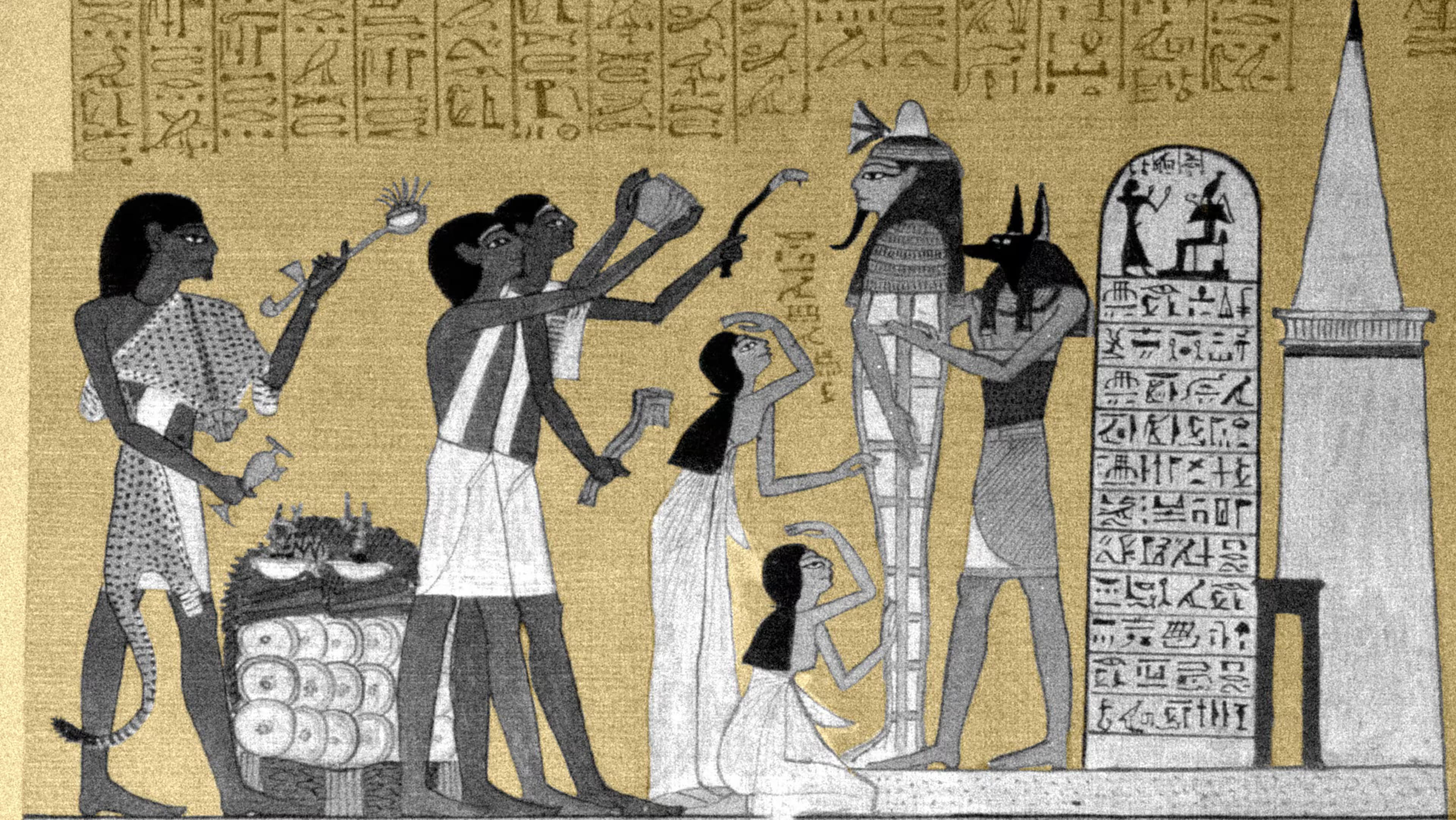
Egyptian beliefs extended beyond earthly life. Many Egyptians hoped to continue living after death, and preparing for the afterlife became an important religious concern. Mummification preserved the body through careful preparation, drying, and wrapping. Elaborate treatments and richly furnished tombs were more accessible to wealthy people, so burial practices also reveal differences in resources and status. In a well-known judgment scene, the deceased person's heart was weighed against the feather of Ma'at. This linked hopes for the afterlife with ideas about truth and proper conduct. Religious belief could encourage ethical behavior by presenting a person's actions as important beyond death.
Pyramids and temples made these beliefs visible on an enormous scale. The pyramids at Giza were royal tombs within larger religious complexes, expressing concern for the king's afterlife and demonstrating the state's ability to organize resources. Building them required planning, food supplies, transport, skilled workers, and coordinated labor. Many workers were free people, including those performing labor obligations owed to the state; ancient Egypt also had enslaved people, so its labor system should not be reduced to a single category. Temples were places of worship and important centers of resources and employment. Their lasting materials and monumental size connected religious purposes with royal prestige and the hope of permanence.
Egyptian art communicated ideas about order and authority through recognizable visual patterns. Pharaohs were often idealized, appearing strong and composed. In many scenes, a figure's size signaled importance rather than realistic physical height. Crowns, divine symbols, and repeated poses helped viewers identify rulers and gods. Hieroglyphic writing, which emerged by around 3200 BCE, recorded names, prayers, royal achievements, and other messages. Egyptians also wrote on papyrus, a paper-like material made from a Nile plant. Measurements such as the cubit, mathematical knowledge, and a 365-day calendar supported construction and administration. Art, writing, and practical knowledge helped preserve culture while strengthening institutions.
Egypt's achievements depended on a society with unequal levels of wealth and authority. Farmers supported the food supply, while scribes, craftspeople, priests, soldiers, and officials performed specialized work. Women could own property and conduct business, although opportunities depended on status and circumstances. Hatshepsut's reign shows that a woman could become pharaoh and use royal imagery, temples, and religious claims to present her authority. Yet sacred kingship could not prevent every crisis. Political divisions, costly wars, and foreign conquests transformed Egypt over time, and it became a Roman province in 30 BCE. Egypt therefore offers evidence for a careful claim: shared beliefs can make government seem legitimate and unite people around it, but lasting power also depends on resources, institutions, and the ability to govern.
Why It Matters
Ancient Egypt helps us investigate how people come to accept a government's authority. Shared religious beliefs connected the pharaoh's leadership with order, justice, protection, and the afterlife. Temples, tombs, and royal images made that connection visible. Studying these sources helps us recognize that buildings and artwork can communicate political messages as well as cultural values. It also helps us distinguish between a ruler's claim to authority and the practical work of governing. By asking who created a message, what it asks people to believe, and whose interests it supports, we learn to evaluate historical evidence and construct stronger arguments about how belief shapes power.
?
How did the Nile and the surrounding deserts help support a centralized government?
Why might presenting a pharaoh as divine make people more willing to accept the ruler's authority?
What responsibilities did maintaining Ma'at place on the pharaoh?
How could religious traditions create unity while also supporting unequal political power?
How did beliefs about judgment after death connect religion with ethical behavior?
What can pyramids and temples tell us about both religious beliefs and government organization?
How did Egyptian artists use size, symbols, and idealized images to communicate authority?
What does Hatshepsut's reign reveal about the relationship between gender, religion, and royal authority?
Is shared belief more effective than law in supporting a government, or do they work together? Explain using Egyptian examples.
Construct a claim answering 'How does belief shape government?' Support it with two examples from Ancient Egypt and explain one limit of belief as a source of power.
Dig Deeper
Crash Course covers the long, long history of ancient Egypt, Learn about mummies, pharaohs, pyramids, and the Nile.
Related

Mummification in Ancient Egypt
Ancient Egyptian mummification was a complex religious and scientific process designed to preserve the body for the afterlife and protect the soul’s journey beyond death.
Montgomery Bus Boycott, Greensboro Sit-In, and the Rise of MLK
From Montgomery’s buses to Greensboro’s lunch counters, ordinary citizens ignited extraordinary change — and a new national leader emerged.
The Haudenosaunee Confederacy: Indigenous Roots of American Democracy
Long before the Founding Fathers gathered in Philadelphia, a league of Native Nations had already established one of the world’s oldest participatory democracies—an Indigenous blueprint for unity, peace, and governance.
Further Reading
Stay curious!