

What Is History? Thinking Like a Historian
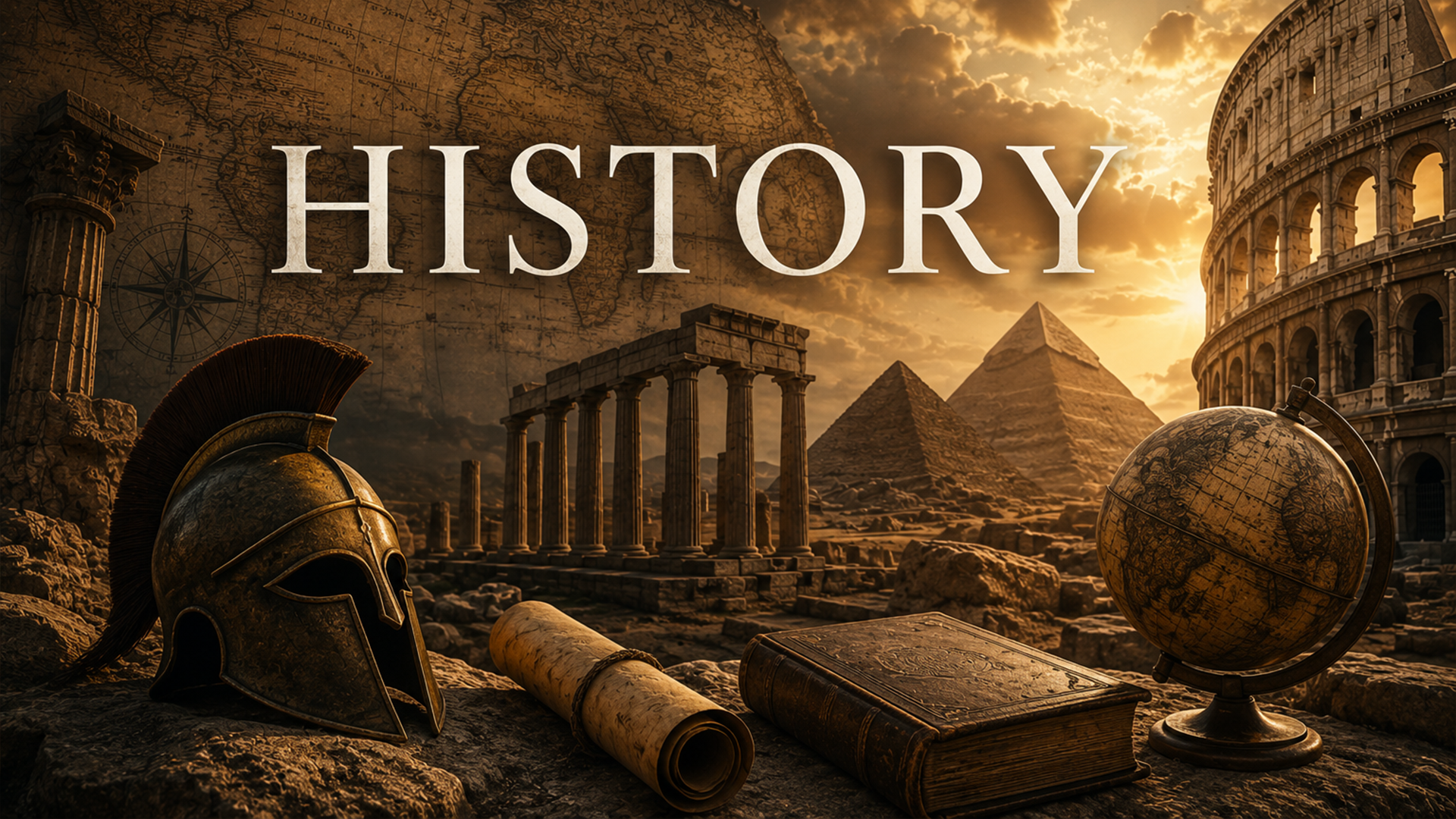
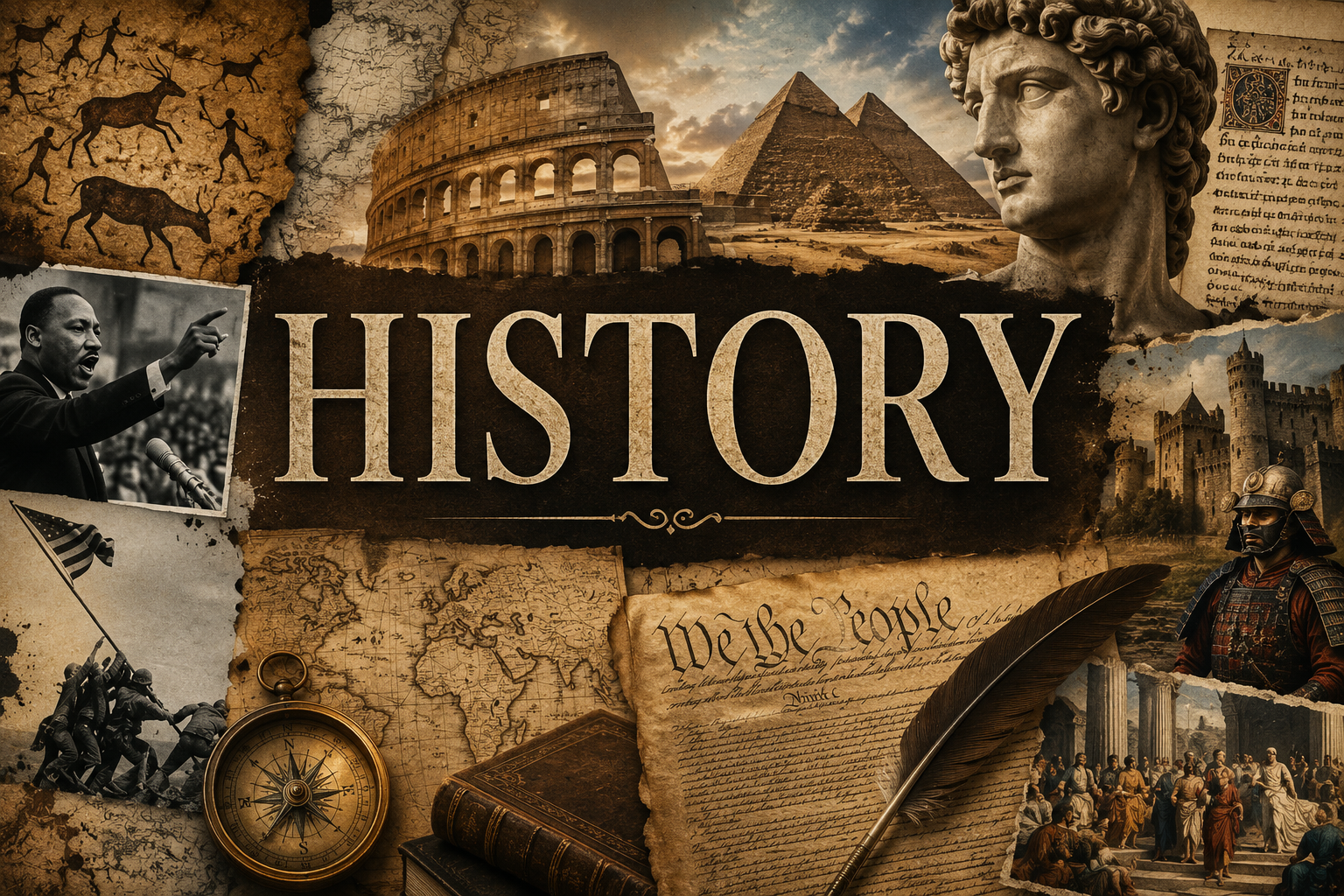
Historian examining historical documents, photographs, maps, and artifacts
The Dive
History is often mistaken as merely a collection of names, dates, and battles to memorize. In reality, history is something much bigger. It is the story of humanity—our ideas, decisions, relationships, triumphs, failures, discoveries, and struggles. More importantly, history is the process of investigating those stories to better understand how our world came to be. Every law we follow, every technology we use, every tradition we celebrate, and every challenge we face has a history behind it. When we study history, we are not simply looking backward—we are learning how to better understand the present and make wiser decisions about the future.
The word history comes from the ancient Greek word historia, meaning 'inquiry' or 'knowledge gained through investigation.' That definition reveals something important: history is not just about remembering facts. It is about asking questions. Historians are investigators. Like detectives solving a case, they gather evidence, examine documents, compare different accounts, and search for patterns. They ask questions such as: What happened? Why did it happen? Who made these decisions? Who benefited? Who was harmed? What changed because of these events? Rather than accepting every story at face value, historians carefully examine the evidence before drawing conclusions.
That evidence comes from many different sources. Some sources were created during the time being studied. These are called primary sources and include letters, diaries, speeches, photographs, newspaper articles, government records, artwork, maps, interviews, and artifacts. Other sources are written later by historians who study and interpret those original materials. These are known as secondary sources. Both types of evidence are valuable, but neither tells the entire story on its own. Historians must ask important questions about every source: Who created it? Why was it created? What perspective does it represent? What information might be missing? Every piece of evidence provides another clue, but no single clue solves the whole mystery.
This is why history is not simply a list of facts—it is also an act of interpretation. Imagine hundreds of people attending the same concert, sporting event, or community celebration. If each person wrote about what happened, every account would be slightly different. One person might focus on the music, another on the crowd, and another on something unexpected that happened nearby. None of those accounts would necessarily be wrong, but each would tell only part of the story. History works the same way. Different historians may examine the same evidence and reach different conclusions because they ask different questions or emphasize different pieces of evidence. Good historical interpretations are not based on personal opinions alone. They are supported by reliable evidence, logical reasoning, and careful analysis.
Thinking like a historian means asking questions that go beyond simply remembering what happened. Historians explore cause and effect, looking at how one decision led to another and how many different factors often combine to create major events. They also study change and continuity. Some things change dramatically over time, while others remain surprisingly consistent across generations. Understanding both helps explain why societies develop the way they do. History reminds us that major events rarely have a single cause. Revolutions, scientific breakthroughs, economic crises, social movements, and technological innovations all result from many decisions made by many people over long periods of time.
History is also much more than the stories of kings, presidents, generals, or famous inventors. Every society has been shaped by ordinary people as well as well-known leaders. Workers built cities. Farmers fed nations. Scientists made discoveries. Artists inspired new ways of thinking. Teachers passed knowledge to future generations. Immigrants carried ideas across continents. Indigenous peoples preserved cultures and traditions that existed long before modern nations. Women, children, entrepreneurs, laborers, activists, and countless others all helped shape the course of history. By studying many different perspectives, historians gain a richer and more complete understanding of the past. Recovering voices that were ignored or forgotten helps us see history as the complex story of humanity rather than a single, simple narrative.
Studying history also teaches skills that extend far beyond the classroom. Historians learn how to evaluate evidence, recognize bias, compare competing viewpoints, identify misinformation, construct logical arguments, and communicate clearly using evidence to support their ideas. These are the same skills used by journalists investigating stories, scientists testing ideas, lawyers building cases, business leaders making decisions, and citizens evaluating information. In today's world, where information spreads faster than ever before, the ability to separate reliable evidence from unsupported claims is one of the most valuable skills anyone can develop.
History also helps us understand why the world looks the way it does today. Modern governments, legal systems, economic institutions, scientific discoveries, and cultural traditions did not appear overnight. They developed through countless decisions made by people over hundreds or even thousands of years. Understanding those decisions provides important context for current events. While history does not repeat itself exactly, it often reveals patterns in human behavior. People have always faced questions about power, justice, freedom, conflict, cooperation, innovation, and change. Learning how previous generations responded to these challenges helps us think more carefully about the choices we face today. History cannot predict the future, but it can make us better prepared to shape it.
History also teaches humility and empathy. Looking into the past reminds us that people lived in circumstances very different from our own. Their beliefs, technologies, opportunities, and challenges were often unlike anything we experience today. Instead of judging the past too quickly, historians try to understand why people made the decisions they did based on the world they knew. This does not mean every decision was right or every action should be excused. Rather, it encourages us to understand complexity before rushing to conclusions. The more perspectives we consider, the more thoughtful and informed our own judgments become.
Ultimately, history is an ongoing conversation between the past and the present. It is not a frozen collection of facts carved into stone, but a living discipline that continues to grow as new evidence is discovered and new questions are asked. The goal of studying history is not simply to remember what happened. It is to understand people, recognize patterns, evaluate evidence, appreciate different perspectives, and become thoughtful participants in our communities and our democracy. When we learn to think like historians, we gain something far more valuable than knowledge of the past—we gain the wisdom to better understand the present and the responsibility to help build a better future.
Why It Matters
History is more than a record of the past. It is one of the most powerful tools for understanding the present. Every political system, scientific discovery, social movement, technological innovation, and cultural tradition has been shaped by earlier choices and events. Studying history helps us evaluate evidence, recognize bias, understand multiple perspectives, and think critically about the information we encounter every day. These skills make us better students, better problem-solvers, and better citizens. History does not tell us exactly what the future will be, but it helps us understand how human decisions shape the world and reminds us that the choices we make today will become part of tomorrow's history.
?
What is the difference between a primary source and a secondary source?
Why can two historians disagree about the same historical event?
How do historians decide whether a source is reliable?
Why is it important to study the experiences of ordinary people as well as famous leaders?
What does it mean to think like a historian?
How do historians identify cause and effect in historical events?
Why doesn't history simply 'repeat itself'?
How can studying history help people make better decisions today?
Dig Deeper
Explore how historians study the past, how the discipline has changed over time, and why history remains essential for understanding the modern world.
The School of Life examines how history can help us better understand contemporary problems, human behavior, and society.
Related
Cause & Effect, Consequences, and Decision Making
If you kick a ball into a table, what might happen next? Welcome to the world of cause and effect! This deep dive explores how actions lead to outcomes and how learning to spot those patterns can help us make smarter decisions every day.
Foundations of Debate
Debate isn’t just for politicians or lawyers—it’s something you’ve probably done with friends when deciding what game to play. At its heart, debate is about listening, making strong arguments, and learning how to disagree respectfully.
Spotting Logical Fallacies & Questioning Assumptions
When someone tries to trick your brain with bad logic, can you catch it? Learn how to spot common logical fallacies—and why asking smart questions makes you a better thinker.
Further Reading
Stay curious!