

The Constitution: Drafted in a Room Full of Genius, Grit, and Compromise
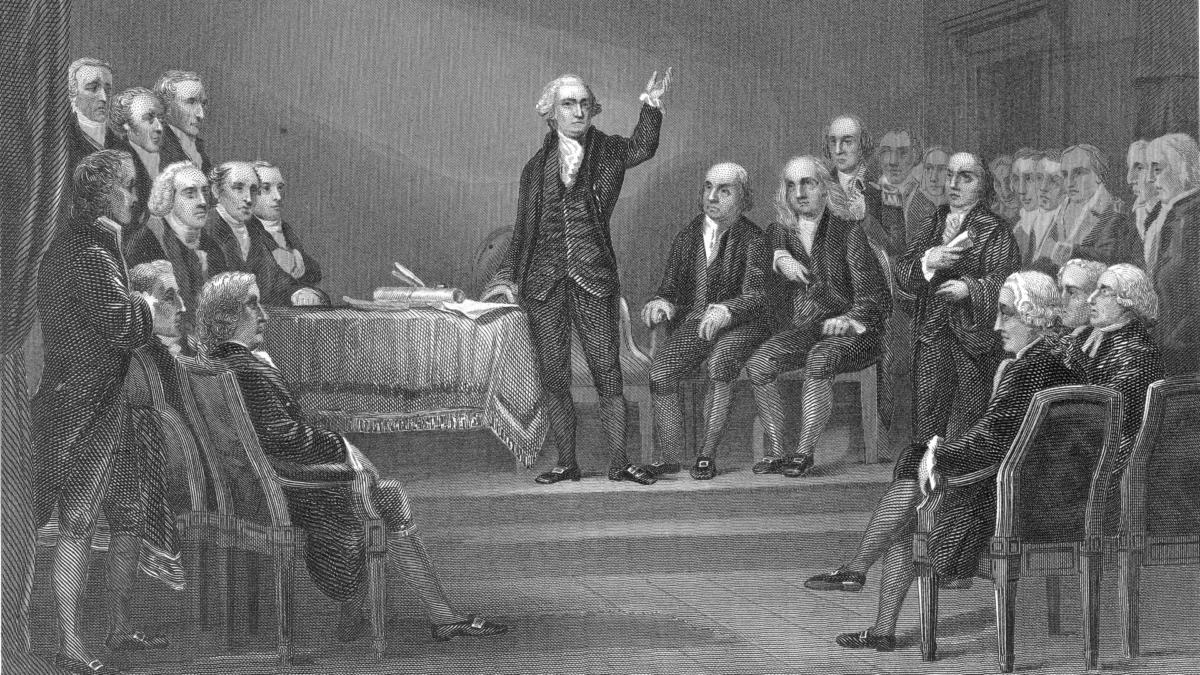
Constitutional Convention with George Washington presiding.
What Happened?
The summer of 1787 began with broken promises, empty coffers, and a lot of nervous states. The Articles of Confederation, America’s first experiment in self-rule, had proven too weak to unify the country. So, on May 25, 1787, 55 men from 12 of the 13 states (shoutout to Rhode Island for ghosting) met in Philadelphia’s Pennsylvania State House with one mission: fix the system. What they did instead was scrap it and start over.
They didn’t know they were drafting one of the most enduring political documents in human history. They just knew what wasn’t working: no president, no power to tax, and zero muscle to stop rebellion or economic collapse. Under George Washington’s steady gaze and James Madison’s relentless note-taking, the delegates devised a new kind of government: a federal republic defined by checks, balances, and the wild idea that power should come from the people, not kings or congresses alone.
The convention didn’t go down like a TED Talk. It was messy. Factions clashed. Tempers flared. Big states demanded more votes. Small states cried foul. Slavery—America’s original sin—was sidestepped and compromised on in painful and lasting ways. The infamous Three-Fifths Compromise and the fugitive slave clause ensured that human bondage would be embedded in the new system from day one.
The biggest breakthroughs came not from shouting but from compromise. The Connecticut Compromise gave us the bicameral legislature we still have today, one house by population (the House) and one with equal state votes (the Senate). The presidency? A half-royal, half-republican solution, elected not by the people directly but through the Rube Goldberg machine we now call the Electoral College.
And yet, despite its flaws, what emerged from that hot, secretive chamber was a Constitution that created a framework for democratic evolution. The Founders didn’t agree on everything—many had deep reservations about the final document. But they agreed on this: something had to hold the country together. And that something had to be flexible enough to stretch as the country grew. Hence, the amendment process. Hence, the Bill of Rights, added in 1791. Hence, us.
Why It Matters
This wasn’t a moment of perfection—it was a moment of possibility. The U.S. Constitution is less a monument and more a living question: How do we balance liberty and order, federal and local power, majority rule and minority rights? Every generation answers it differently. That’s the point. The Constitution wasn’t written to stop change. It was written to make change possible.
?
What were the weaknesses of the Articles of Confederation that led to the Constitutional Convention?
Why was the Three-Fifths Compromise so controversial, and how did it shape future debates over slavery?
How did the Connecticut Compromise influence the structure of Congress?
What role did secrecy play in the Convention’s success—and how would that approach be viewed today?
Why did the Founders decide against including a Bill of Rights in the original Constitution?
Dig Deeper
A quick, punchy breakdown of the Articles of Confederation, the creation of the Constitution, and the messy magic of federalism in early America.
Related
The Great Depression: America in Crisis
The Great Depression was more than a stock market crash — it was a decade-long test of American resilience that reshaped the nation's economy, politics, and daily life.
The Haudenosaunee Confederacy: Indigenous Roots of American Democracy
Long before the Founding Fathers gathered in Philadelphia, a league of Native Nations had already established one of the world’s oldest participatory democracies—an Indigenous blueprint for unity, peace, and governance.
Westward Expansion, Sectionalism, and the Road to Civil War
Manifest Destiny fueled territorial growth, but it also deepened sectional divides—turning political disagreements over slavery and states’ rights into irreconcilable conflicts that led to civil war.
Further Reading

Stay curious!