

Galileo Begins Observing the Moon
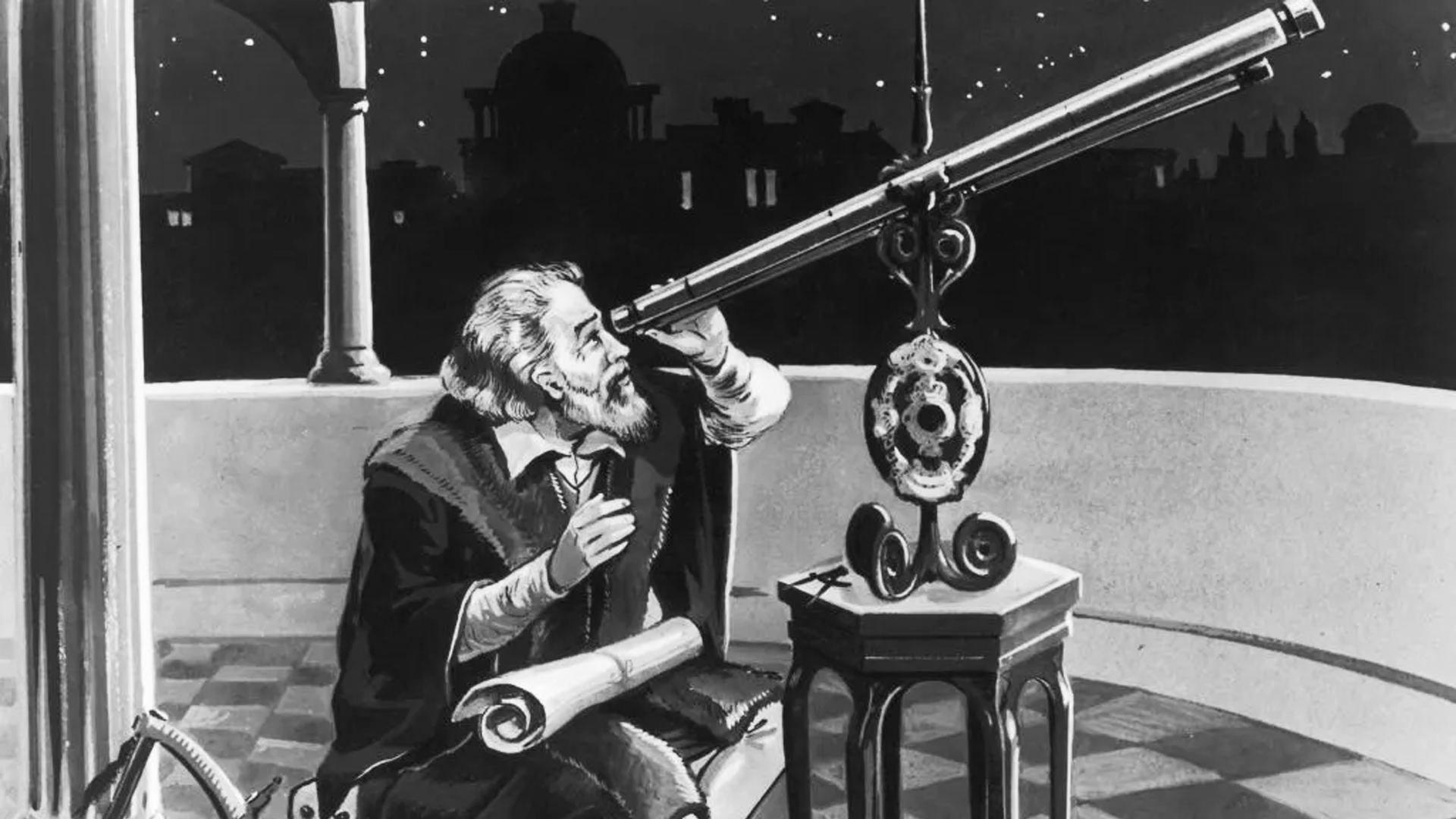
Galileo observing the Moon through one of his early telescopes
What Happened?
Pointing a telescope at the sky might seem like no big deal, but in 1609 it was an act that shook the foundations of how people understood the universe. On a quiet night in late November, Galileo Galilei climbed to the roof of his home in Padua, Italy, and aimed a homemade telescope at the Moon. What he saw transformed science forever: the Moon wasn’t a flawless, glowing sphere, as people had believed for almost 2,000 years. Instead, it had mountains, valleys, and craters just like Earth.
At the time, most scholars followed the teachings of the ancient philosopher Aristotle, who argued that everything beyond Earth was perfect, smooth, and unchanging. Earth alone was messy, cracked, and imperfect. Galileo’s careful drawings of the Moon’s rugged landscape proved that this old idea didn’t match reality. His telescope showed that the Moon had shadows cast by mountains, bright slopes lit by the Sun, and dark craters that revealed depth and shape.
Galileo didn’t invent the telescope, but he improved it dramatically. After hearing rumors about a Dutch-made spyglass, he rushed home and engineered his own version, grinding lenses by hand and experimenting until he created a tool with far greater magnification. His early telescope could make distant objects appear three to eight times larger which was enough to transform the sky from a mystery into a map of new scientific clues.
Once he realized how powerful his invention was, Galileo used it not just for curiosity but for careful investigation. He sketched what he saw, took notes on how shadows changed night to night, and treated the Moon like a physical place, not just a distant light in the sky. These observations became the heart of his famous 1610 book 'Sidereus Nuncius' (or 'Starry Messenger'), the first published scientific work based entirely on telescopic discoveries.
Galileo’s discoveries didn’t stop at the Moon. Over the next months, he observed the four largest moons of Jupiter, showing that not everything in space revolved around Earth. He watched Venus change shape like the Moon, proving that it orbited the Sun. Each new finding added evidence to the Copernican model of the solar system, which placed the Sun, not Earth, at the center.
These ideas challenged powerful institutions, especially the Catholic Church, which had woven Aristotle’s geocentric (Earth-centered) universe into its teachings. While Church leaders accepted some of Galileo’s observations, they rejected the idea of a moving Earth and, eventually, put him on trial for defending heliocentrism. Galileo was forced to deny his scientific conclusions and spent his final years under house arrest, but the ideas he championed continued to spread.
What matters most about Galileo’s moon-gazing night in 1609 isn't just the discovery of mountains or craters. It’s the shift in mindset he sparked. Galileo proved that the universe could be understood not by tradition or authority, but by observation, evidence, and critical thinking. He helped launch the scientific revolution, a shift that encouraged people to ask questions, test ideas, and embrace curiosity as a tool for uncovering truth.
That November night marks one of the first moments when a human being looked at the Moon and understood it as a real, physical world. Galileo’s discovery reminds us that science begins when someone dares to look closely, think differently, and trust what they observe. Even when it challenges everything people once believed.
Why It Matters
Galileo’s observations of the Moon were a turning point in the history of science because they showed that the universe isn't ruled by perfect, unchanging spheres, but by natural laws that can be discovered through observation and evidence. His work helped shift thinkers away from superstition and toward scientific reasoning, laying the foundation for modern astronomy, physics, and the idea that knowledge grows through questioning, experimenting, and learning from the world around us.
?
Why was it important that Galileo sketched what he saw instead of just describing it?
How did the belief that heavenly bodies were 'perfect' influence science before telescopes were invented?
What does Galileo’s curiosity teach us about how scientific discoveries are made?
Why did Galileo’s discoveries challenge both scientists and religious leaders of his time?
How did improving a simple invention—the telescope—change our understanding of the entire universe?
In what ways do modern space tools (like satellites and rovers) continue the work Galileo began?
Dig Deeper
A vivid look at how Galileo transformed a simple telescope into a revolutionary scientific tool and used it to make discoveries that changed humanity’s understanding of the cosmos.
Related

U.S. Imperialism: The Spanish-American War and Its Aftermath
In 1898, the United States fought Spain in a short war that reshaped its identity—from a republic born in anti-colonial revolution to a global imperial power with overseas territories.
The Progressive Era: Reform, Regulation, and the Limits of Change
From breaking up monopolies to marching for women’s votes, the Progressive Era sought to fix America’s problems — but often left some voices out of the conversation.

World War II: Causes, Conflict, and Consequences
A global war shaped by unresolved tensions, devastating conflict, and consequences that still define our world today.
Further Reading
Stay curious!