

The Heimlich Maneuver Is Published
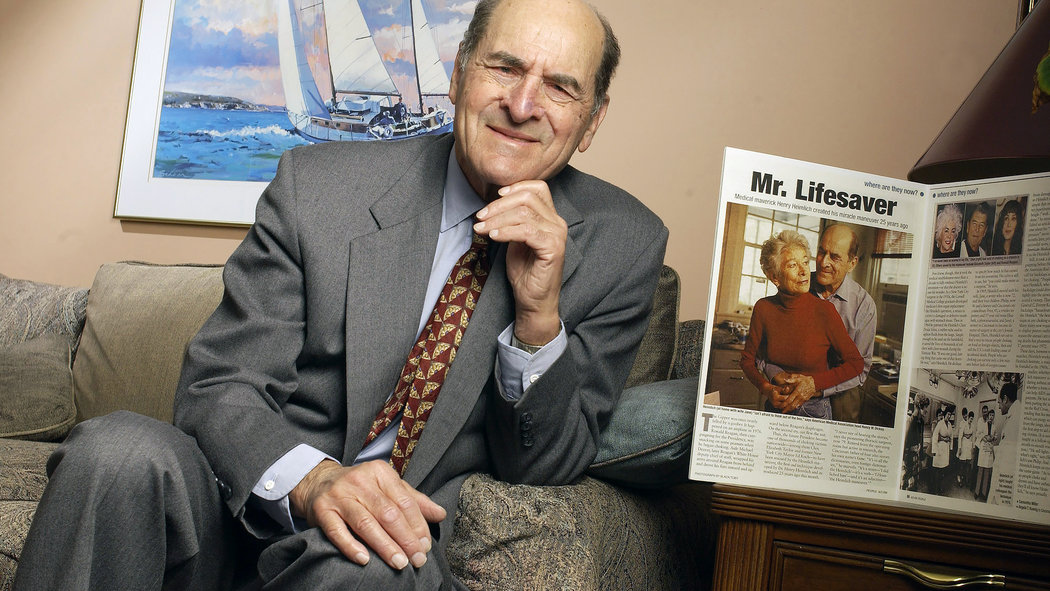
Photo of Dr. Henry Heimlich demonstrating the Heimlich maneuver on a dummy.
What Happened?
Dr. Henry Heimlich wasn’t trying to become a household name, he was just trying to stop people from choking to death at dinner. In 1974, he published a short article in the journal Emergency Medicine titled 'Pop Goes the Café Coronary,' where he explained a radical new idea: instead of making a hole in someone’s throat (a tracheostomy), why not use the air still in their lungs to pop the blockage out?
That idea—quick, upward thrusts just below the ribcage—hadn’t yet been tested on people. But Heimlich had tried it on dogs, more than 20 times per dog. It worked. So he decided to share it with the world.
At first, the medical world wasn’t convinced. For a while, most doctors still recommended the 'backslap method,' but slowly, the Heimlich maneuver caught on. Why? Because it worked. Not in labs. Not in theory. But in restaurants, kitchens, classrooms, and senior living homes.
In fact, years later—at age 96—Heimlich himself would save a choking woman in his own retirement community. She was turning blue. He stood up. Wrapped his arms around her. Three thrusts later, she coughed up the piece of hamburger. That was the first time he’d ever used his technique to save someone’s life in the moment. And it worked.
Since then, the Heimlich maneuver has saved over 50,000 lives in the United States alone. You’ve probably seen the poster in your school cafeteria or learned it in health class. It's one of those rare inventions that turns anyone into a hero in less than ten seconds.
As of today, June 1 is recognized as National Heimlich Maneuver Day—a moment to remember that a little knowledge (and a lot of courage) can save a life.
Why It Matters
You don’t need to be a doctor to save a life. That’s the power of the Heimlich maneuver. It’s a reminder that science isn’t just about lab coats—it’s about solving problems with empathy, clarity, and a refusal to accept that choking has to end in tragedy.
?
Why do you think the Heimlich maneuver took so long to be accepted by the medical community?
What qualities made Dr. Heimlich’s idea so powerful and lasting?
Can you think of other inventions that empower everyday people to help others in emergencies?
Why do you think Heimlich didn’t use his own maneuver in an emergency until decades later?
Should schools teach the Heimlich maneuver and CPR as part of required health education?
Dig Deeper
Jim Morelli explains the science behind the Heimlich maneuver and how it turns regular people into emergency responders in seconds.
Related
The Gulf of Tonkin Incident: A Turning Point in the Vietnam War
A disputed naval encounter that led to full-scale U.S. involvement in Vietnam—and raised lasting questions about power, truth, and war.
The French and Indian War: The Battle for North America
Before the American Revolution, another great war reshaped North America—the French and Indian War. It began as a fight over land and power, but ended up changing the map of the world and planting the seeds of independence.
The Columbian Exchange: When Worlds Collided
When two previously isolated worlds collided in 1492, the resulting biological, cultural, and economic transformation reshaped every corner of the globe. The Columbian Exchange was not just a swap—it was a world-changing, world-breaking chain reaction.
Further Reading

Stay curious!