

Rosa Parks Ignites the Montgomery Bus Boycott
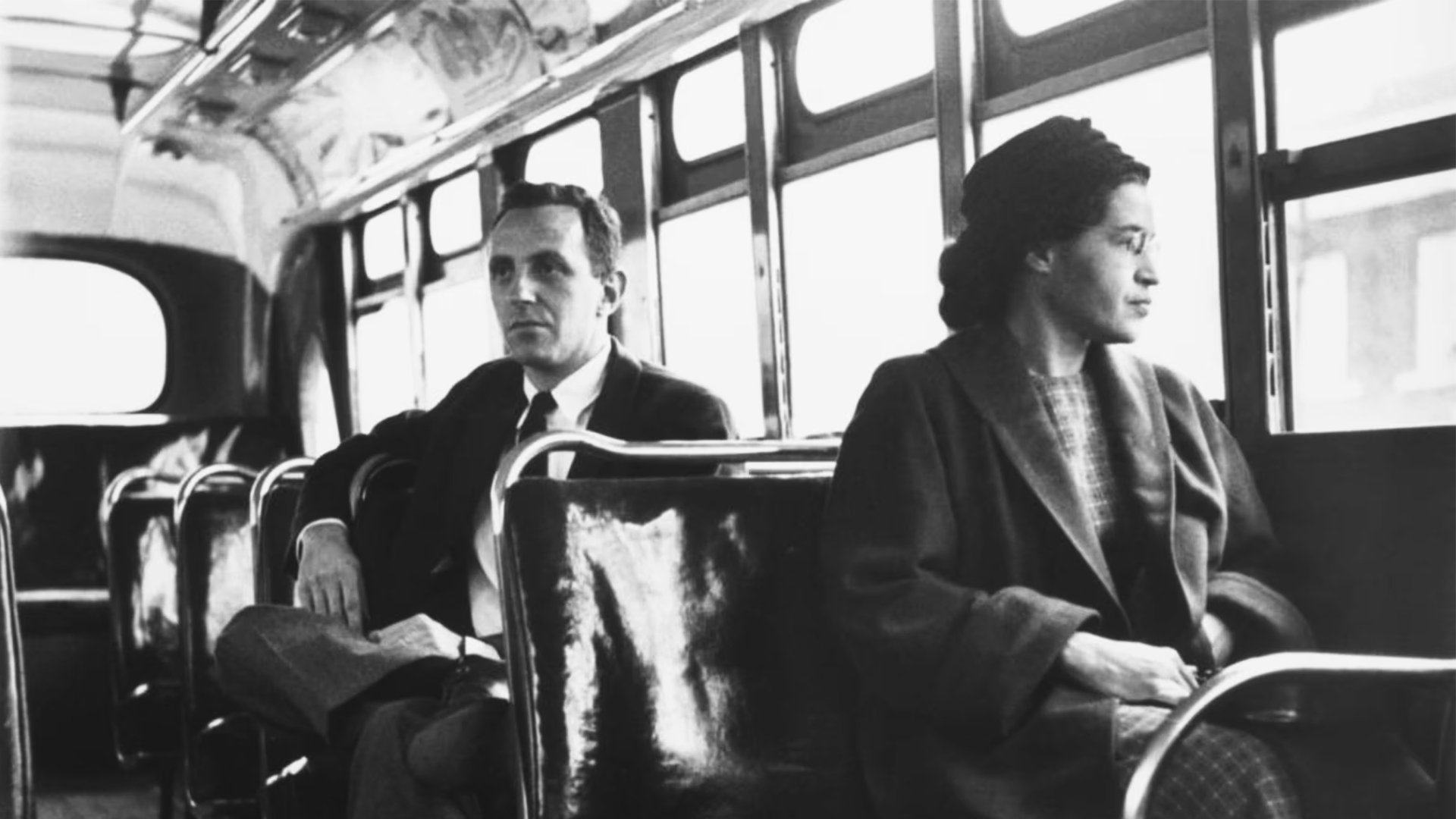
Rosa Parks sitting near the front of a Montgomery city bus after segregation was struck down
What Happened?
In the 1950s, Montgomery, Alabama, was ruled by Jim Crow laws (rules that separated Black and white people in almost every part of daily life). On city buses, Black riders had to sit in the back section and were forced to give up their seats if the white section filled up. It was written into city law. Black riders paid the same fares, but they were treated as if their comfort and dignity didn't matter.
Born in 1913 in Tuskegee, Alabama, Rosa Parks grew up seeing the Ku Klux Klan march past her house and hearing about lynchings in her community. As an adult, she worked as a seamstress and spent years as a committed activist. She joined the Montgomery chapter of the NAACP in 1943, served as its secretary, and helped investigate cases of racial violence and discrimination. By the time she boarded that bus in 1955, she had already spent more than a decade quietly organizing for justice.
On the evening of December 1, 1955, Rosa Parks sat in the first row of the section where Black riders were allowed to sit. When the white section filled up, the bus driver ordered her and three other Black passengers to give up their seats. The others moved. Parks didn't. She later explained that she wasn't physically exhausted, just deeply tired of giving in to unfair rules. Her calm refusal broke the city’s segregation law, and she was arrested and charged with disorderly conduct.
Local leaders had been waiting for the right case to challenge Montgomery’s bus system. Rosa Parks was well-known, respected, and deeply involved in the movement, which made her arrest a powerful rallying point. The Women’s Political Council and the NAACP quickly spread the word, calling for Black residents to boycott, or refuse to use, the city buses on December 5, the day of Parks’ trial. Handbills were printed, churches announced the plan, and people quietly prepared to walk, carpool, or take Black-owned taxis instead of riding segregated buses.
The one-day protest was so successful that activists decided to keep going. They formed the Montgomery Improvement Association (MIA) to coordinate the boycott and chose a 26-year-old pastor, Dr. Martin Luther King Jr., as their president. Under his leadership, the community organized carpool systems, held mass meetings in churches, and used nonviolent language and tactics, even as white supremacists tried to intimidate them with threats and violence. King’s home was bombed, many were harassed or fired from their jobs, yet the boycott held strong.
For 381 days, Black residents of Montgomery mostly stayed off the buses, even though many had to walk miles to work and school. Because Black riders made up around 70 percent of bus customers, the bus company lost huge amounts of money. The boycott showed how powerful economic pressure could be when a community stands together. It also attracted national and international attention, forcing people across the country to confront the injustice of segregation.
While the streets were filled with walkers and carpoolers, lawyers were at work in the courts. In a case called Browder v. Gayle, several Black women who had been mistreated on Montgomery buses challenged the city’s segregation laws. In November 1956, the U.S. Supreme Court ruled that segregating passengers on public buses violated the 14th Amendment’s guarantee of equal protection under the law. This decision made bus segregation illegal, not just in Montgomery, but across all of Alabama.
On December 20, 1956, after the Supreme Court’s ruling took effect, Dr. King announced that the boycott was officially over and encouraged Black citizens to return to the buses ‘on a non-segregated basis.’ The next day, Rosa Parks rode again, this time without being forced to move for a white passenger. The Montgomery Bus Boycott became a model for future civil rights campaigns and helped launch Martin Luther King Jr. as a national leader of the movement.
Rosa Parks paid a personal price for her courage. She lost her job, faced constant threats, and eventually moved to Detroit in 1957 to seek a safer life. However, she continued her activism, working with the NAACP and serving on Congressman John Conyers’ staff, helping people who were homeless and in need. She also helped create the Rosa and Raymond Parks Institute for Self-Development to support and train young people. Her life reminds us that the famous moment on the bus was part of a long, steady journey of resistance.
Why It Matters
Today, Rosa Parks is remembered as a symbol of quiet, powerful bravery, a reminder that one person’s decision to say ‘no’ to injustice can spark a movement. Her refusal to give up her seat did more than challenge one unfair law, it exposed an entire system of racial injustice and showed how organized, nonviolent protest could break it. The Montgomery Bus Boycott proved that when a community is united, patient, and determined, it can force powerful institutions to change. This story is a blueprint for civic action: learn the problem, stand with others, use your voice and your choices, and keep going even when the cost is high. The struggle for civil rights isn't just history; it is a living reminder that justice depends on ordinary people refusing to accept what is wrong as ‘just the way things are.’
?
Why do you think Rosa Parks’ act of resistance on that particular day sparked such a large and organized response?
How did the Montgomery Bus Boycott show the power of everyday choices, like whether or not to ride the bus?
What role did organizations like the NAACP and the Women’s Political Council play in turning one arrest into a larger movement?
Why was nonviolence such an important strategy for Martin Luther King Jr. and the Montgomery Improvement Association?
In what ways did the Supreme Court’s decision in Browder v. Gayle connect to the promises of the 14th Amendment?
How can students today use the lessons of Rosa Parks and the bus boycott to stand up against unfairness in their own schools and communities?
Dig Deeper
A short explainer on how Rosa Parks’ refusal to move on a Montgomery bus helped ignite the Civil Rights Movement and inspire nonviolent protests across the United States.
Explore the life of Rosa Parks and discover how she became a civil rights activist, starting with her work with the NAACP.
Related

Civics vs. Ethics
Civics explains the rules of society. Ethics asks whether those rules are right.
Free Market Fever: The Deregulation Debate
When is government the problem—and when is it the solution? Deregulation reshaped the U.S. economy, slashing rules and reshuffling power in the name of freedom and efficiency.
Understanding Triggers
Triggers aren’t just reactions, they’re messages from our past asking to be understood.
Further Reading
Stay curious!